Timing belts get a lot of attention, but the pulleys used in a timing drive are just as important for maximum performance. You might not find the pulley you need right off the shelf, but BRECOflex can help. Below, find a breakdown of different timing pulley customization options available so you can get the exact components you need, and the support necessary to get the design right from the start.
There are several ways to order custom pulleys from BRECOflex, depending on the support you need.
Submit a drawing: If you already have a technical drawing or model of the pulley you need, it can be submitted directly through our Custom Pulley RFQ form. Because drawings often have most of the necessary specifications included, this is often the easiest and most efficient way to order a custom pulley.
Fill out the RFQ form: Fill out the Custom Pulley RFQ form, which includes questions regarding common customizations. If a customization you need is not listed on the form, include the feature and relevant specifications in the “Additional Details” section of the form.
Call and Contact Us form: If you need additional support or have further questions, you can call BRECOflex directly at +1 (732) 460-9500 or complete the Contact Us form on our website. Our team can connect you with the resources necessary to design and purchase a custom pulley.
Re-ordering a custom pulley
Looking to re-order a custom pulley? Include the inventory number (BP00X000) printed on the side of the pulley when requesting a quote to get details for the exact same pulley. Can’t ID your pulley? Use our contact us form to get help with identifying your part for free.
Custom Timing Pulley Options
There are several pulley customization options, including flanges, keyways, set screws, bushing machining, materials, and more. Learn about the available customizations and the specifications needed to quote made-to-order pulleys below.
Pulley flanges
Flanges are raised edges attached to one or both sides of a pulley to keep timing belts tracking properly. All synchronous drives can benefit from flanged pulleys, but they are especially useful in vertical lift drives, designs with multiple pulleys, and systems with long belt spans.
There are several options for choosing pulley flanges from BRECOflex:
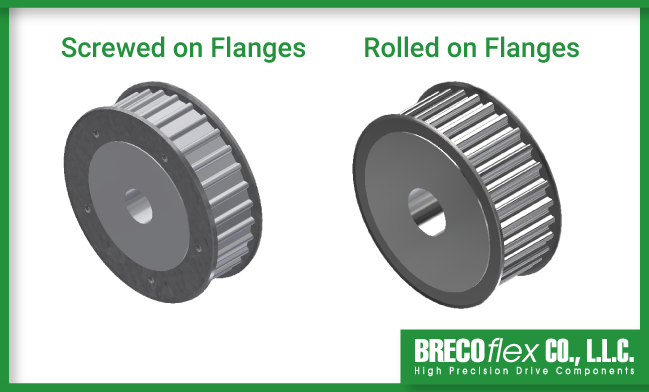
Rolled-on flanges: Attached by machining shoulders on the pulley sides that hold the flanges, which are then rolled and pressed securely on. Rolled-on flanges are standard for flanged pulleys AT15 pitch or lower.
Screwed-on flanges: Providing a stronger connection, screwed-on flanges are common in drives in demanding conditions where a belt may generate higher tracking forces, like drives using larger pitches, wider pulleys, higher belt tensions, or high-strength belts, like the move-series. Screwed on flanges are often thicker, requiring more space. They may not fit on all pulleys.
Flange materials: Three pulley flange materials are available to meet specific application environment needs. Zinc-plated steel is standard for most pulleys, while aluminum and stainless steel (standard with stainless steel or Delrin pulleys) flanges are also available.
What information is needed when specifying pulley flanges?
To ensure your pulley is manufactured correctly, include the following information on your drawing or quote request:
Number of flanges: 1 or 2 flanges
Flange type: Rolled-on (standard) or screwed-on
Flange material (if required): Zinc-plated steel (standard), aluminum, or stainless steel
Part Number Reference
The number of flanges is identified at the end of BRECOflex pulley part numbers:
[Material][Width over Hub][Pitch]/[# of Teeth]-[# of Flanges]
Example:
AL 55 AT10 / 20 - 2
In this example, the "-2" indicates the pulley has two flanges.
Hubs
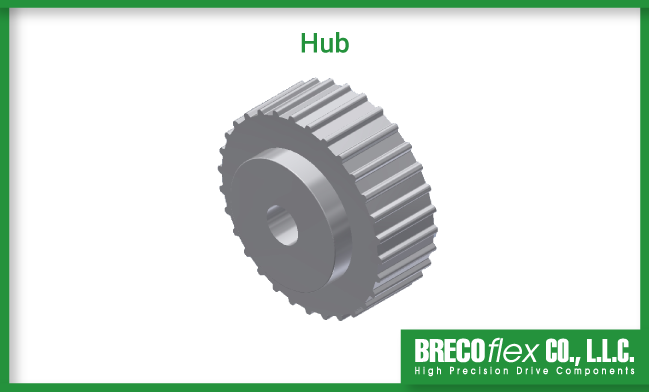
A pulley hub is a raised section at the center of the pulley that improves the connection between the pulley and the shaft. The additional hub material allows for greater torque capacity, eases maintenance and mounting, and improves design flexibility by allowing a wider range of bore and keyway sizes and different set screw locations.
Although they can provide significant benefits, not every pulley has a hub. Pulleys without hubs are most commonly used in compact drives that have significant space or weight restrictions.
BRECOflex can accommodate one hub, two symmetric or asymmetric hubs, and stepped hubs.
What information is needed when specifying pulley hubs?
Be sure drawings or quote requests for pulleys with hubs include:
Number of hubs: 1 or 2 hubs
Hub diameter (mm)
Hub depth (mm)
For asymmetric hubs, the hub diameter and length for each must be provided. For stepped hubs, include the diameter and length of each “hub step”.
One of the most important design features of a pulley is the diameter of the bore. It must be properly sized so the pulley can be mounted onto the shaft securely. The bore diameter is limited by the overall size of the pulley and if a keyway is needed. This prevents the pulley wall from being too thin, which could lead to it breaking under the load or torque the application requires.
In addition to the bore diameter, bore tolerance, which outlines the slight, allowable variation in the bore size, is another consideration. The bore tolerance ultimately dictates how the pulley is mounted to the shaft, and how tightly they fit together. The following bore tolerances are available from BRECOflex:
H7: Standard bore tolerance
H6: Tightest bore tolerance
H8: Typical bore tolerance for keyless bushings
M6: Typical bore tolerance for press fit
Clr: Clearance of bore +0.1mm/-0.0mm
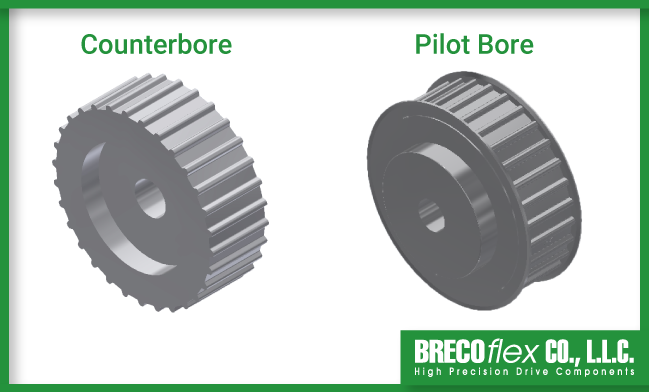
Counterbores can also be added to a pulley to reduce weight or provide clearance for shaft shoulders and other hardware. These recessed bores are precision machined directly into the pulley, and are also popular for designs that house bearings, pairs with bushings, or to allow fasteners to sit below the pulley face. BRECOflex can accommodate one, two symmetric, two asymmetric, or stepped counterbores.
Basic pilot bores are available for pulleys that will be machined with finished bores, keyways, or set screws after purchasing.
What information is needed when specifying custom pulley bores?
Be sure drawings or quote requests for pulleys with custom bore diameters include:
Bore diameter (mm)
Bore tolerance
Details to include for counterbores include:
Counterbore diameter (mm)
Counterbore depth (mm)
Tolerance(defaults to standard if not specified)
For asymmetric counterbores, include the diameter and depth of each counterbore. For stepped counterbores, include the diameter and depth of each “step”.
Self-tracking guide
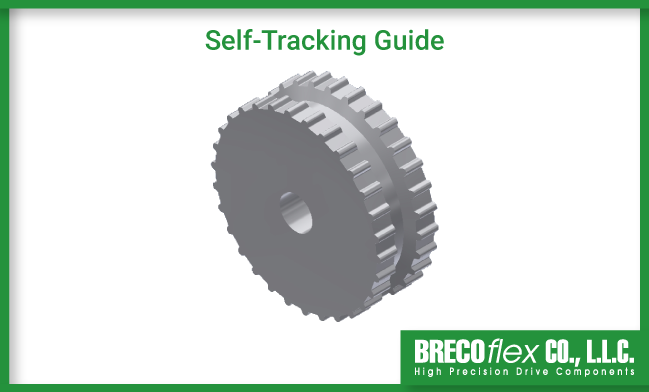
Self-tracking guides are grooves machined on the tooth side of the pulley to pair with self-tracking timing belts. Using self-tracking components reduces belt movement and improves tracking without having to use flanges, making them popular for compact drives, or designs where flanges interfere with product transport, clearances, or general operation.
Self-tracking grooves are tapered, with the widest part at the top of the tooth, which gradually narrows at depth. There are three different self-tracking groove dimensions:
K6: A 6.5mm wide* self-tracking groove with a 5mm depth**
K10: A 10.5mm wide* self-tracking groove with a 7mm depth**
K13: A 13.5mm wide* self-tracking groove with a 7.5mm depth**
The grooves can be machined centered on the pulley or offset, depending on the design needs. Imperial tracking guides can also be used, when needed.
*Groove width at top of tooth, +0.2/-0.0 mm tolerance
** +0.1/-0.0 mm tolerance
What information is needed when specifying pulley self-tracking grooves?
The self-tracking dimensions are usually denoted in the part number as part of the pulley pitch and require no additional information. The following example outlines a part number for a self-tracking pulley:
AL 55 AT10K13 / 20-0
If a self-tracking groove is to be offset from the center, please indicate the distance to the center of the groove from the pulley face.
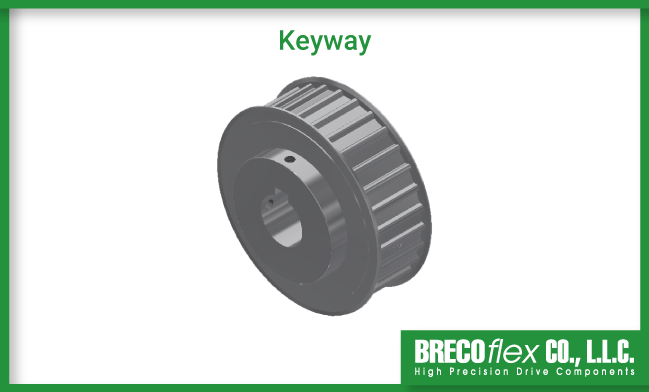
A keyway is a slot that is machined into the bore of a pulley to match a keyed shaft, helping prevent it from slipping on the shaft. That extra reinforcement provided by the keyway promotes reliable torque transmission, even in demanding applications. Often, keyways are paired with set screws to further stabilize the pulley.
Keyway sizes are standardized and vary by bore size, but the alignment can vary. The default keyway alignment is on the tooth gap, with tooth alignment also available.
What information is needed when specifying pulley keyways?
Be sure drawings or quote requests for pulleys with keyways include:
Bore size: Bore size determines the dimensions of the keyway
Keyway alignment:Either on the tooth gap (default) or the tooth
Set Screws
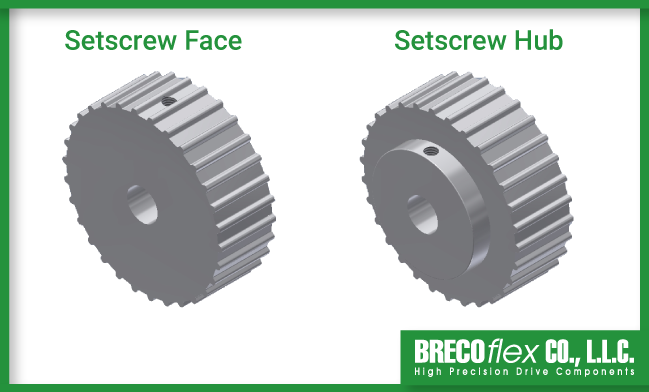
Threaded set screw holes can be added to the face or hub of BRECOflex pulleys to secure the pulley to a shaft and prevent rotation and axial movement. Any number of set screws can be added to the pulley, but the majority of applications need no more than two.
The ideal location for a set screw hole varies with performance needs and design constraints.
Set screws on the pulley hub are easier to access and simplify maintenance, especially when timing belts are mounted.
Set screws on the pulley face are often used in applications with space constraints that restrict the use of hubs. However, they are more difficult to service when belts are mounted.
For high-torque loads, set screws alone might not provide enough strength to hold the pulley in place, so they are often paired with a keyway and keyed shaft.
What information is needed when specifying pulley set screws?
TBe sure drawings or quote requests for pulleys with set screws include:
Set screw locations:Pulley hub or pulley face
Set screw amount: One or two set screws, more can be accommodated on request.
Bushing Machining
Bushings are popular components used in industrial drives that securely connect pulleys to shafts. The reliable attachment provided by bushings increases torque capacity and allows a single pulley design to fit multiple shaft diameters, which makes design, procurement, and replacement more flexible.
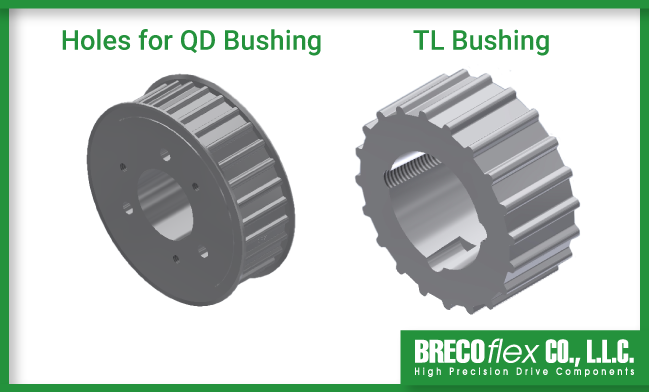
Pulleys must be machined to accept a bushing attachment. BRECOflex offers custom machining for pulleys to match with either taper-lock (TL) bushings or quick detachable (QD) bushings.
Get keyless bushings from BRECOflex. Keyless bushings can be purchased directly from BRECOflex, and our Application Engineers can assist with selecting the right pulley, material, and modifications needed for the bushing and application.
What information is needed when specifying pulley bushing machining?
Be sure drawings or quote requests for pulleys machined for bushings include:
Bushing style: Taper-lock style bushing or quick detachable (QD) bushing
TL bushing type: Informs the machining specifications. Examples include 3535, 4040, 4545
QD bushing type: Informs the machining specifications. Examples include JA, SH, SDS
QD bushing hole type: QD bushing machining can be prepared with threaded and thru holes, threaded holes only, or thru holes only.
Materials and coatings
Several pulley material and coating options are available to improve application performance and environmental resistance:
Aluminum: As a cost-effective and lightweight material, aluminum is the standard material for BRECOflex stock, modified stock, and custom pulleys. It offers moderate corrosion resistance, lower rotational inertia, and can reduce the amount of torque needed to accelerate and decelerate the pulley.
Stainless steel: A durable, abrasion resistant material with excellent corrosion and chemical resistance compared to aluminum or carbon steel. Stainless steel pulleys are suitable for high power transmission, harsh-duty applications, and washdown environments and are commonly used in food, pharmaceutical, medical, and FDA-regulated applications.
Steel: Ideal for high power transmission and applications that require high strength, durability, and abrasion resistance. Steel pulleys are substantially heavier than aluminum pulleys and are susceptible to corrosion unless an additional finish is applied.
Delrin®/Acetal: A non-metallic pulley material for lower power transmission applications, light-duty conveying, or applications that require the distinct lightweight, non-metallic properties Delrin® pulleys offer. Though Delrin® pulleys have excellent resistance to many chemicals and moisture, they are not suitable for all chemicals, high loads, high temperatures, or abrasive environments.
BRECOflex offers a variety of coating and plating materials for pulleys to improve performance and longevity, including anodizing, hard anodizing, black oxide, zinc plating, chromate, and nickel plating. Additional coatings and finishes are available on request.
What information is needed when specifying custom pulley materials and coatings
Select the material and or finish needed on the online RFQ form. Pulley material can also be denoted in the part number as follows:
Aluminum:AL 55 TK10K13 / 30-0
Stainless Steel: VA 55 TK10K13 / 30-0
Steel: ST 55 TK10K13 / 30-0
Delrin®: POM 55 TK10K13 / 30-0
Other finish or material requests can be included via the additional details section of the RFQ form or can be communicated directly to the customer service or engineering representative you work with.
Reduced / Zero backlash tooth gap
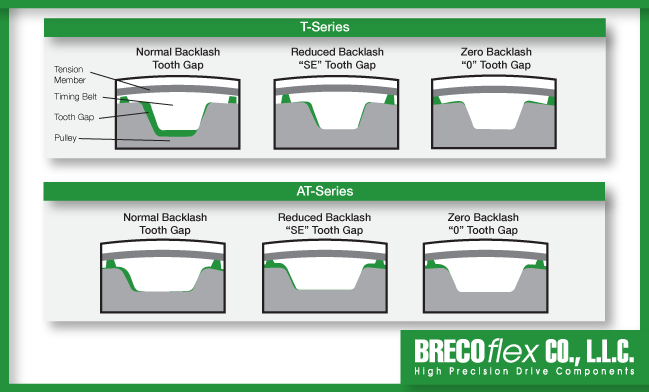
Backlash is a measure of the motion lost in a drive as a belt tooth moves across the gap between the tooth and the pulley groove. While backlash is normal in a timing drive, some applications, especially those that require high levels of repeatability like reversible drives, need to minimize it.
Reduced and zero backlash T and AT series pulleys are available from BRECOflex (including self-tracking versions), which can improve positional accuracy, repeatability and settling time in a drive system. With reduced backlash, tooth clearance is decreased, while zero backlash removes as much clearance as possible.
Note: Systems using reduced and/or zero backlash pulleys may require closer attention to belt fit, tension, alignment, and operating conditions. Zero backlash can potentially reduce belt life and may impact the overall design and belt selection.
Consult with our Application Engineers for free for more information.
What information is needed when specifying reduced or zero backlash pulleys?
Reduced and zero backlash options can be selected directly on the Custom Pulley RFQ form. Backlash type can also be denoted within the part number:
Reduced Backlash “SE”: AL 42 AT10-SE/24-2
Zero Backlash “0”: AL 42 AT10-0/24-2
Standard tooth design is applied in the absence of a backlash selection.
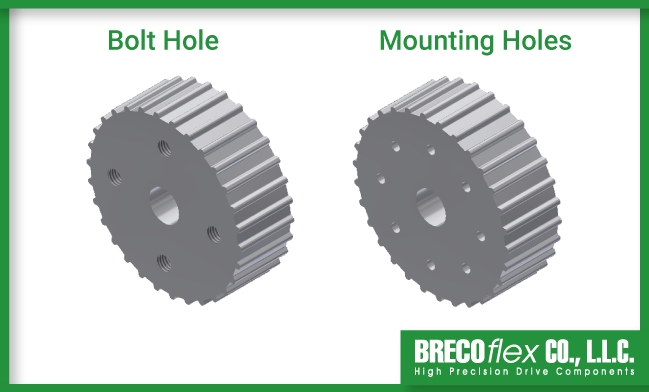
Bolt and mounting holes are common pulley customizations, typically used to attach components to the pulley, mount the pulley on another part, or allow bolts to pass through into another component. The holes are added to the side of the pulley, often in a bolt circle diameter.
Options for custom pulley bolt and mounting holes include:
Threaded or non-threaded holes
Through or blind holes
What information is needed when specifying pulley bolt or mounting holes?
Be sure drawings or quote requests for pulleys machined with bolt or mounting holes include:
Hole Type: Threaded, non-threaded, through, or blind
Number of holes
Hole diameter (mm)
Bolt circle diameter (mm)
Bolt circle alignment (if applicable)
Lightening holes and lightening grooves
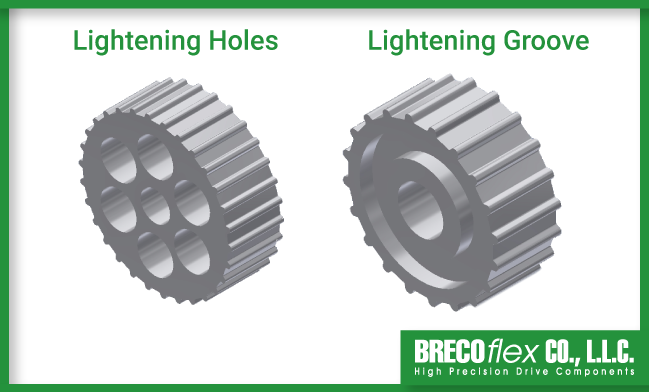
Lightening holes and lightening grooves are modifications that reduce pulley weight and rotational inertia, which lowers the amount of torque needed to accelerate or decelerate the pulley.
By reducing the load on shafts and bearings, lightening machining options make it so pulleys put less stress on other components, while simultaneously helping reduce drive noise and vibration. This is especially useful for larger pulleys or those made of heavy materials, like steel.
Choosing between lightening holes or lightening grooves depends on the application’s needs:
Lightening holes are holes drilled through the pulley face and act as a simple way to reduce the weight of a pulley. This is a simple manufacturing process and removes the maximum amount of mass.
Lightening grooves are pockets machined into the pulley, creating a recessed groove. It’s a more complex manufacturing process than lightening holes, but it provides more structural integrity and a closed surface to prevent contaminants from passing through the pulley.
What information is needed when specifying lightening holes or lightening grooves?
Be sure drawings or quote requests for pulleys machined with lightening holes include:
Number of holes
Hole diameter (mm)
Bolt circle diameter (mm)
Bolt circle alignment (if applicable)
For lightening grooves, indicate:
Number of lightening grooves: One or two grooves
Outer groove diameter (mm)
Inner groove diameter (mm)
Groove depth (mm)
If two non-identical lightening grooves are needed, indicate the outer diameter, inner diameter, and depth of each separately.
Snap ring groove
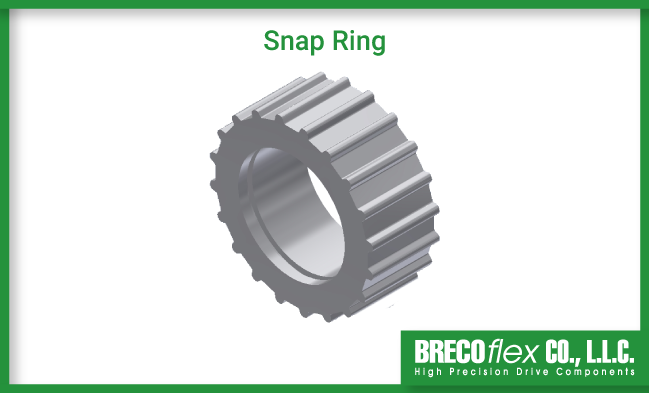
Grooves can be machined on a pulley bore or hub to accept a retaining or snap ring to hold the pulley on the shaft and prevent axial movement. Snap rings help maintain pulley alignment and simplify the installation process, but they must be paired with features like keyways, set screws, or bushings to prevent rotational movement and strengthen torque transmission.
What information is needed when specifying snap ring grooves?
Be sure drawings or quote requests for pulleys machined with snap ring grooves include:
Number of grooves:One or two
Groove diameter (mm)
Groove thickness (mm)
Distance to groove center from pulley edge (mm)
Center to center distance of grooves (mm) (if applicable)
Get pulleys as unique as your application
When you get custom pulleys through BRECOflex, you’re not just getting the component you need. You have access to our in-house engineering experts for free design support, prototyping, machine-to-print capabilities, and easy procurement of compatible timing belts, clamps, and other accessories. Ready to get started? Contact us today!